Minute - Lord Willoughby de Eresby [1950-11-13]
Dublin Core
Title
Subject
Description
Creator
Source
Date
Contributor
Minute Item Type Metadata
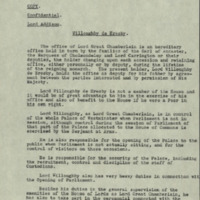
Transcript
Page 1
COPY.
CONFIDENTIAL.
LORD ADDISON.
Willoughby de Eresby.
The office of Lord Great Chamberlain is an hereditary office held in turn by the families of the Earl of Ancaster, the Marquess of Cholmondeley and Lord Carrington or their deputies, the holder changing upon each accession and retaining office, either personally or by deputy, during the lifetime of the reigning monarch. The present holder, Lord Willoughby de Eresby, holds the office as deputy for his father by agreement between the parties interested and by permission of His Majesty.
Lord Willoughby de Eresby is not a member of the House and it would be of great advantage to him in the exercise of his office and also of benefit to the House if he were a Peer in his own right.
Lord Willoughby, as Lord Great Chamberlain, is in control of the whole Palace of Westminster when Parliament is not in session, although control during the session of Parliament of that part of the Palace allocated to the House of Commons is exercised by the Serjeant at Arms.
He is also responsible for the opening of the Palace to the public when Parliament is not actually sitting, and for the control of visitors on these occasions.
He is responsible for the security of the Palace, including the recruitment, control and discipline of the staff of Custodians.
Lord Willoughby also has very heavy duties in connection with the Opening of Parliament.
Besides his duties in the general supervision of the amenities of the House of Lords as Lord Great Chamberlain, he has also to take part in the ceremonial connected with the introduction of Peers.
Page 2
Lord Willoughby de Eresby would, if he were a member of the House, be in a much stronger position, for he could then be appointed a member of the House of Lords Offices Committee (where matters of staffing, including his own staff, and amenities are considered for report to the House) and speak and vote at meetings. At present, he is not admitted to the sittings of the House, nor is he more than an observer at meetings of the Offices Committee, and is only by courtesy allowed access to the Library etc.
I do not suggest that a new peerage should be created in Lord Willoughby’s favour; in fact I do not think it is necessary. If the proposal should meet with approval, I suggest that it could be carried out by calling him up in his father’s barony of Willoughby de Eresby. There are many precedents for this — the most recent, I think, being the cases of the present Marquess of Salisbury who was (in 1941) called up in his father’s barony of Cecil of Essendon, and the present Earl of Selborne who, in the same year, was called up in his father’s barony of Selborne. For this purpose it would be necessary for the Prime Minister to make a recommendation to His Majesty, when His Majesty would, if he approved the recommendation, direct the Home Secretary to issue a Warrant to the Lord Chancellor for a Writ of Summons to Parliament to be issued to Lord Willoughby de Eresby.
While the calling up of Lord Willoughby would add temporarily to the numbers of the House of Lords, the barony would again merge in the Earldom of Ancaster when he succeeded his father as Earl of Ancaster. It would thus be no more than a temporary expedient to enable Lord Willoughby to execute his duties as Lord Great Chamberlain to the best of his capability, and it is obvious that his position to do this would be improved if he were a member of the House equally with those over whose activities in the Palace of Westminster he is in some position of control, instead of, as at present, being himself outside its membership and therefore not able to attend its sittings and watch its proceedings from the floor of the House. I should add that I have no doubt that Lord Willoughby would be agreeable to be regarded as a non-political Peer while in charge of his office as Lord Great Chamberlain in his father’s lifetime.
(Sgd) R. L. OVERBURY.
13th November, 1950.
Signatures
Special Features
Files