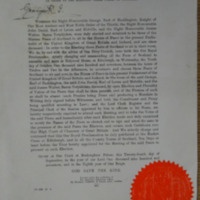
Royal Proclamation - For Electing Three Peers of Scotland [1917-09-24]
Dublin Core
Title
Subject
Description
Creator
Source
Date
Contributor
Relation
Coverage
Royal Proclamation Item Type Metadata
Transcript
BY THE KING.
A PROCLAMATION
In order to the Electing three Peers of Scotland.
(Sgd.) George R I
Whereas the Right Honourable George, Earl of Haddington, Knight of Our Most Ancient and Most Noble Order of the Thistle, the Right Honourable John David, Earl of Leven and Melville, and the Right Honourable James Walter, Baron Torphichen, were duly elected and returned to be three of the Sixteen Peers of Scotland to sit in the House of Peers in the present Parliament of the United Kingdom of Great Britain and Ireland, and are since deceased: In order to the Electing three Peers of Scotland to sit in their room, We do, by and with the advice of Our Privy Council, issue forth this Our Royal Proclamation, strictly charging and commanding all the Peers of Scotland to assemble and meet at Holyrood House, at Edinburgh, on Wednesday, the Tenth day of October, One thousand nine hundred and seventeen, between the hours of Twelve and Two in the Afternoon, to nominate and choose three Peers of Scotland to sit and vote in the House of Peers in this present Parliament of the United Kingdom of Great Britain and Ireland, in the room of the said George, Earl of Haddington, the said John David, Earl of Leven and Melville, and the said James Walter, Baron Torphichen, deceased, by open Election and Plurality of Voices of the Peers that shall be then present, and of the Proxies of such as shall be absent (such Proxies being Peers, and producing a Mandate in Writing duly signed before Witnesses, and both the Mandate and Proxies being qualified according to Law); and the Lord Clerk Register and the Principal Clerk of the Session appointed by him to officiate in his Name, are hereby respectively required to attend such Meeting, and to take the Votes of the said Peers, and immediately after such Election made and duly examined to certify the Names of the Peers so elected, and to sign and attest the same in the presence of the said Peers the Electors, and return such Certificate into Our High Court of Chancery of Great Britain: And We strictly charge and command that this Our Royal Proclamation be duly published at the Market Cross at Edinburgh, and in all the County Towns of Scotland, Ten Days at least before the Time hereby appointed for the Meeting of the said Peers to proceed on such Election.
GIVEN at Our Court at Buckingham Palace, this Twenty- fourth day of September, in the year of our Lord One thousand nine hundred and seventeen, and in the Eighth year of Our Reign.
GOD SAVE THE KING.
[L. S.]
Ornamentation
Special Features
Files