Minute - Background Note on the Home Secretary's Role in Signing Investigatory Warrants [2000-06-16]
Dublin Core
Title
Subject
Description
Creator
Source
Date
Contributor
Minute Item Type Metadata
Transcript
CONFIDENTIAL AND PERSONAL
HOME SECRETARY: RESPONSIBILITY FOR WARRANTS
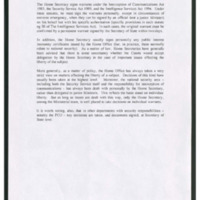
The Home Secretary signs warrants under the Interception of Communications Act 1985, the Security Service Act 1989, and the Intelligence Services Act 1994. Under these statutes, he must sign the warrants personally, except in circumstances of extreme emergency, when they can be signed by an official (not a junior Minister) on his behalf but with his specific authorisation (specific provisions in each statute eg S6 of The Intelligence Services Act). In such cases, the original warrant must be confirmed by a permanent warrant signed by the Secretary of State within two days.
In addition, the Home Secretary usually signs personally any public interest immunity certificates issued by the Home Office (but, in practice, these normally relate to national security). As a matter of law, Home Secretaries have generally been advised that there is some uncertainty whether the Courts would accept delegation by the Home Secretary in the case of important issues effecting the liberty of the subject.
More generally, as a matter of policy, the Home Office has always taken a very strict view on matters affecting the liberty of a subject. Decisions of this kind have usually been taken at the highest level. Moreover, the national security area – including both the Security Service itself and the responsibility for interception of communications – has always been dealt with personally by the Home Secretary, rather than delegated to junior Ministers. This reflects the basic stand on individual liberty. But as long as the wider Cabinet sees the Home Secretary as dedicated, among the Ministerial team, is well placed to take decisions on individual warrants.
It is worth noting, also, that in other departments with security responsibilities – notably the FCO – key decisions are taken, and documents signed, at Secretary of State level.
CONFIDENTIAL AND PERSONAL
Files