Royal Warrant - For Letters Patent Appointing a Supreme Court Judge [2022-10-03]
Dublin Core
Title
Subject
Description
Creator
Source
Date
Contributor
Royal Warrant Item Type Metadata
Transcript
(Sgd.) Charles R
Our will and pleasure is that this pass by immediate Warrant
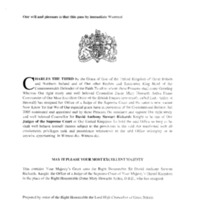
CHARLES THE THIRD by the Grace of God of the United Kingdom of Great Britain and Northern Ireland and of Our other Realms and Territories King Head of the Commonwealth Defender of the Faith To all to whom these Presents shall come Greeting Whereas Our right trusty and well beloved Counsellor Dame Mary Howarth Arden Dame Commander of Our Most Excellent Order of the British Empire (commonly called Lady Arden of Heswall) has resigned her Office of a Judge of the Supreme Court and the same is now vacant Now Know Ye that We of Our especial grace have in pursuance of the Constitutional Reform Act 2005 nominated and appointed and by these Presents Do nominate and appoint Our right trusty and well beloved Counsellor Sir David Anthony Stewart Richards Knight to be one of Our Judges of the Supreme Court of Our United Kingdom To hold the said Office so long as he shall well behave himself therein subject to the provisions in the said Act mentioned with all emoluments privileges rank and precedence whatsoever to the said Office belonging or in anywise appertaining In Witness &c. Witness &c.
MAY IT PLEASE YOUR MOST EXCELLENT MAJESTY
This contains Your Majesty’s Grant unto the Right Honourable Sir David Anthony Stewart Richards, Knight, the Office of a Judge of the Supreme Court of Your Majesty’s United Kingdom in the place of the Right Honourable Dame Mary Howarth Arden, D. B. E., who has resigned.
Prepared by order of the Right Honourable the Lord High Chancellor of Great Britain
Received the 3rd day
of October 2022
(Sgd.) Brandon Lewis
Countersigner
Ornamentation
Printed in Times New Roman.
Royal name begins with a drop cap and is capitalized and in boldface.
Appointee's name and office are in boldface.
Special Features
The Letters Patent are almost identical to the Letters Patent by which Lords of Appeal in Ordinary were appointed (cf. the Royal Warrant for Lord Walker of Gestingthorpe's Letters Patent). One difference is that Judges of the Supreme Court are granted "emoluments privileges rank and precedence" while Lords of Appeal in Ordinary were granted "wages profits privileges rank and precedence."
Files