Minute - Recommending That the Lord Chancellor's Ecclesiastical Patronage Revert to the Crown [2003-12-03]
Dublin Core
Title
Subject
Description
Creator
Source
Date
Contributor
Minute Item Type Metadata
Transcript
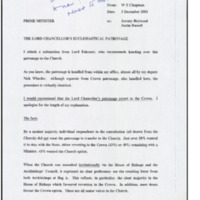
[illegible] Your advice
to me has been sound up
to now! So let it revert to the Crown
From: W E Chapman
Date: 3 December 2003
cc: Jeremy Haywood
Justin Russell
PRIME MINISTER
THE LORD CHANCELLOR’S ECCLESIASTICAL PATRONAGE
I attach a submission from Lord Falconer, who recommends handing over this patronage to the Church.
As you know, the patronage is handled from within my office, almost all by my deputy Nick Wheeler. Although separate from Crown patronage, also handled here, the procedure is virtually identical.
I would recommend that the Lord Chancellor’s patronage revert to the Crown. I apologise for the length of my explanation.
The facts
By a modest majority individual respondents to the consultation (all drawn from the Church) did not want the patronage to transfer to the Church. Just over 50% wanted it to stay with the State, either reverting to the Crown (43%) or (8%) remaining with a Minister. 43% wanted the Church option.
When the Church was consulted institutionally via the House of Bishops and the Archbishops’ Council, it expressed no clear preference-see the resulting letter from both Archbishops at flag A. This reflects, in particular, the clear majority in the House of Bishops which favoured reversion to the Crown. In addition, most deans favour the Crown option. These are all senior voices in the Church.
Page 2
The Archbishop of Canterbury personally favours transfer to the Church. I believe the Archbishop of York sees the value of the Crown taking on the role, because it provides a level playing field to those who belong to a Church minority (in his case, the traditionalist Catholic wing). The Crown tries to work above Church politics.
It is incorrect to say that the current system interferes with reorganisation, as Lord Falconer suggests. Under Nick Wheeler, proposals for reorganisanisation are always co-operated with. Indeed, the consultation has confirmed the high regard for Nick’s sensitive and collaborative working of the system.
Transfer to the Church would make my job in advising you more difficult, as I rely on Nick’s networks in the Church to help me reach a rounded view in giving you advice and in ensuring a good field of candidates for senior posts.
Modernisation
I appreciate of course that abolition of the Lord Chancellor is part of the government’s modernisation programme.
But there is nothing inherently un-modern about a variety of Church patronage, of which the Crown’s patronage is part. Trusts, colleges, private individuals exercise Church patronage, as well as bishops. Diversity is increasingly recognised, as you know, as a vital and valuable part of the modern world-a point made by the Chief Rabbi in his book “The Dignity of Difference”. The Bishops already exercise about 48% of patronage; adding the Lord Chancellor’s would take it into the early 50s. There is nothing conceptually modern in moving toward greater uniformity.
In addition, variety of patronage maintains checks and balances within the Church, particularly important now when passions run high on such matters as the gay issue. For example, had Jeffrey John’s appointment to Reading been more directly in the Crown’s hands, it would arguably not have been derailed. Some bishops do “pack”
Page 3
their dioceses with clergy of a particular churchmanship, or overrule a parish which has requested a particular sort of priest. In exercising patronage from here we try to avoid such things and are widely recognised to do so.
Implications for establishment
I do not think Charlie Falconer’s submission does justice to this part of the argument. Lord Chancellor’s patronage is operated on behalf of the Crown (it was originally the Crown’s patronage entirely). The transfer of such a substantial chunk of “state” patronage (around 450 posts) to the Church would be seen as a significant disengagement and could trigger a move to disestablishment. If disestablishment is to be on the agenda, it ought to be there as a result of proper debate, not as a side produce of a piece of bureaucratic tidying up. It is true that this was not a major factor in the consultation responses but, if the transfer actually happened, I believe people would see the issue more starkly.
Given the implications for Establishment, I understand the Palace may have a view. I wonder whether you might want to touch on this at an Audience.
Conclusion
Practical implications of reversion to the Crown would be minimal. The system would still be worked from here. The Lord Chancellor would no longer play a part. You would have 5 minutes more work a year, signing 25 or so extra formal submissions.
If the Church had voiced an overwhelming preference for transfer to the bishops I would have advised you to acquiesce. But the Church did not-far from it. In these circumstances I believe the wider issues point to reversion to the Crown.
Are you inclined to opt for transfer to the Church—or reversion to the Crown?
Page 4
If the former I should welcome a chance to discuss this with you before you finally decide.
If the latter, and if you wanted to make an accommodating gesture to those who hold the opposing view, we could offer to discuss with the Church the detail of the way the system is operated, in case those discussions threw up improvements. This would underline our existing willingness to keep the system flexible and up-to date.
Whichever option you choose, change could probably be effected administratively. Bu Lord Falconer recommends a section in the Constitutional Reform Bill, given the significance of the issue. Clare thinks this is right. Agree?
Finally, I gather from Lord Falconer’s office that this is not something on which he would want to die in the last ditch, should you disagree with him.
(Sgd.) William
W E CHAPMAN
Signatures
Special Features
Document has a handwritten annotation by Tony Blair indicating that he agreed with Chapman that the Lord Chancellor's ecclesiastical patronage should revert to the Crown. In the end, this didn't happen. These appointments remain a cancellarial duty to this day (some of the instruments involved can be seen elsewhere on the CBAI).
Files