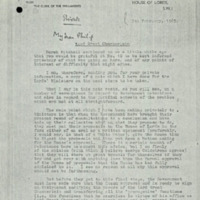
Letter - Next Steps for Transferring Control of the Palace of Westminster [1965-02-05]
Dublin Core
Title
Subject
Description
Creator
Source
Date
Contributor
Letter Item Type Metadata
Transcript
THE CLERK OF THE PARLIAMENTS
S.W.1.
5th February, 1965.
Private
My dear Philip
LORD GREAT CHAMBERLAIN
Derek Mitchell mentioned to me a little while ago that you would be grateful at No. 10 to be kept informed privately of what was going on here, and of any points of interest or difficulty that might arise.
I am, therefore, sending you, for your private information, a copy of a note which I have done for the Lords’ Ministers on the next steps to be taken.
What I say in this note rests, as you will see, on a number of assumptions in regard to Government intentions and also in regard to the juridical aspects of the problem which are not at all straightforward.
The main point which I have been making privately to Ministers is that when the Government have brought their present round of consultations to a conclusion and have made up their collective mind on what they propose to do, they must put their proposals to the House of Lords in the form either of an oral or a written statement (preferably, I would say, in that of a White Paper), give the House time to digest the proposals and then put down a Motion asking for the House’s approval. There is a certain amount of reluctance here to accept this advice, but I am firmly of the opinion (which I believe George Coldstream agrees) that they will store up great trouble for themselves if they try and get away with anything less than the formal approval of the House of proposals that the House has had fully explained to it. I see no reason at all why this approval should not be forthcoming.
But before they get to this final stage, the Government must have made sure that the Queen approves and is ready to sign an instrument modifying the powers of the Lord Great Chamberlain and transferring all the prerogative functions (i.e. the functions which he exercises in virtue of his office as Lord Great Chamberlain, whatever they may be), except the ceremonial functions, to the Speakers of the two Houses.
In this connection I have assumed that the Queen will not sign the instrument until both Houses have agreed to the Government’s proposals. But the relations with the Queen and the various processes of informal and formal approval are, of course, a matter for the Government not for the House of Lords.
Then there is also the matter of consultation with Lord Cholmondeley, with his heirs, and with the other families who have a hereditary interest in the office. Here it would seem to be prudent and courteous for the Government, before they put their proposals to the two Houses, to explain them to the interested parties and to seek their approval, not of what the Government propose to do but of the way in which they propose to proceed. This would diminish the risk of any of the interested parties subsequently claiming that they had been deprived of their rights by illegal means.
I hope this letter may help to keep you in the picture.
Forgive me if I appear to intrude upon Government business. I do so only in so far as the Government proposals affect the House of Lords.
(Sgd.) Yours ever,
David Stephens
P.S. Since dictating this letter, I have been summoned to a meeting of Ministers to discuss my note of yesterday.
D.S.
P. J. Woodfield, Esq., C.B.E.,
10, Downing Street,
S.W.1.
Signatures
Recipient(s)
Files