Letter - Control of the Palace of Westminster [1965-02-04]
Dublin Core
Title
Subject
Description
Creator
Source
Date
Contributor
Letter Item Type Metadata
Transcript
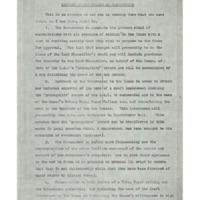
This is an attempt to set out in summary form what the next steps, as I see them, might be.
1. The Government to complete the present round of consultations with all sections of opinion in the House with a view to deciding exactly what they wish to propose to the House for approval. The text that emerges will presumably be on the lines of the Lord Chancellor’s draft and will include provision for transfer to the Lord Chancellor, on behalf of the House, of some of the L.G.C.’s “prerogative” powers and will be accompanied by a map delimiting the areas of the two Houses.
2. Approach by the Government to the Queen in order to obtain Her informal approval of the text of a draft instrument limiting the “prerogative” powers of the L.G.C. to ceremonial and to the care of the Queen’s Robing Room, Royal Gallery etc., and transferring the rest to the Speakers of the two Houses. This instrument will presumably also make some reference to Westminster Hall. This assumes that the “prerogative” powers can be transferred by this means (a legal question which, I understand, has been brought to the attention of Government Ministers).
3. The Government to inform Lord Cholmondeley and the representatives of the other families concerned of the nature and purport of the Government’s proposals; and to seek their agreement to the way in which it is proposed to proceed (in order to secure that they do not subsequently claim that they have been deprived of their rights by illegal means).
4. Presentation to both Houses of a White Paper setting out the Government’s proposals, and including the text of the draft instrument by the Queen and indicating the Queen’s willingness to sign such an instrument; together with a map.
5. Government Motions in both Houses approving the White Paper.
6. Completion of instrument by the Queen.
The position will then be that the L.G.C.’s “prerogative” powers are vested in the Lord Chancellor on behalf of the House; but the powers delegated to the L.G.C. by the House will still be with the L.G.C. The next step would, therefore, seem to lie between the following alternatives:
7. Either the House could decide straightaway to reassign to some specified agent (such as, for example, Captain Mackintosh) both the delegated powers which it is about to withdraw from the L.G.C. and the “prerogative” powers which by then will be vested in the Lord Chancellor.
8. Or, alternatively, if such a decision were thought to be going too quick, the House could resume the delegated powers, vest them in the Lord Chancellor (so as to bring both the delegated and the “prerogative” powers together in one repository), make interim arrangements to carry on the administration of the Lords’ part of the Palace and refer the whole question of the disposal of the two sorts of powers to the Offices Committee for recommendation and report.
I am sending copies of this note to the Lord Chancellor and the Chief Whip.
DAVID STEPHENS.
4th February, 1965.
Signatures
Recipient(s)
Files