Minute - Departmental Restructuring [2000-06-16]
Dublin Core
Title
Subject
Description
Creator
Source
Date
Contributor
Minute Item Type Metadata
Transcript
Page 1
CONFIDENTIAL AND PERSONAL
Secretary of the Cabinet and Head of the Home Civil Service
PRIME MINISTER
DEPARTMENTAL RESTRUCTURING
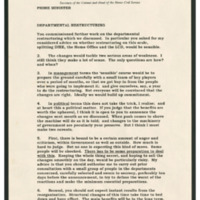
You commissioned further work on the departmental restructuring which we discussed. In particular you asked for my considered advice on whether restructuring on this scale, splitting DfEE, the Home Office and the LCD, would be sensible.
2. The changes would tackle two serious areas of weakness. I still think they make a lot of sense. The only questions are how? and when?
3. In management terms the ‘sensible’ course would be to prepare the ground carefully with a small team of key players over a period of months, so that we got buy-in from the people who were going to implement it; and give ourselves, say, a year to do the restructuring. Not everyone will be convinced that the changes are right. Ideally we would build up commitment.
4. In political terms this does not take the trick, I realise; and at heart this a political matter. If you judge that the benefits are worth the upheaval, I think it is open to you to announce the changes next month as we discussed. When push comes to shove the machine will do as it is told; and changes to the machinery of government are peculiarly your preserve. But I think I must make two caveats.
5. First, there is bound to be a certain amount of anger and criticism, within Government as well as outside. How much is hard to judge. But no one is expecting this kind of move. Some people will be shocked. There has to be some preparation to deal with this. Keeping the whole thing secret, and hoping to sell the changes smoothly on the day, would be particularly risky. My advice is that you should authorise me to carry out prior consultation with a small group of people in the departments concerned, carefully selected and sworn to secrecy, preferably ten days before the announcement, to try to defuse the worst of the reactions and make the minimum essential preparations.
6. Second, you should not expect instant results from the reorganisation. Structural changes of this time take time to bed down and have effect. The main benefits will be in the long term.
CONFIDENTIAL AND PERSONAL
Page 2
CONFIDENTIAL AND PERSONAL
7. The following pages analyse these points in more detail.
Is it sensible?
8. The changes involve big organisational upheaval affecting around 200,000 staff, getting on for half the Government machine. In an ideal world this process should be managed, with careful calculation of three kinds of risk:
i. management disruption. Experience suggests that restructuring has a short term cost in terms of management distraction. The long-term benefits must be worth this short term cost.
ii. upset personalities. This applies most obviously to the people at the top of the organisations, Ministers as well as officials. We have to be careful to explain the splits without sounding as though we are criticising anyone. In the case of DfEE, a lot of effort has been invested in integrating the two departments over the last five years. Blunkett, Bichard and their staff may well feel that they have been wasting their time.
iii. outside opinion. There will be some surprised reactions from outside groups. For instance:
A lot of people including commentators welcomed the merger of the old departments of Education and Employment. They will need to be convinced that it is now right to split.
The old Home Office has a distinguished band of old boys who will probably be thunderstruck by the desecration of a revered institution.
9. In management terms the ‘sensible’ thing would be to plan the reorganisation in detail beforehand over a period of months with the main participants, ensuring buy-in from all the main players, Ministers and civil servants. News of this work would probably seep out, at least to some senior managers and would probably create some uncertainty. But it would be helpful in preparing people for what was to come and minimising the shock and consequent confusion when it happened. Preparation would help the new departments hit the ground running.
10. The management arguments also point to doing the DfEE split first, with the Home Office/LCD following at the next Election. The work which is now being done on the ONE agency under Andrew Smith’s direction is reaching a point where decisions are needed on
CONFIDENTIAL AND PERSONAL
Page 3
CONFIDENTIAL AND PERSONAL
the departmental framework within which the agency will operate: see para 16 below.11. Provided that you judge that the political benefits will be sufficiently strong to outweigh these disadvantages, there is nothing to stop you announcing the whole reorganisation to an unsuspecting world on 7 July. There are no recent precedents for quite such a dramatic reorganisation but experience such as it is supports the view that you can do it.
12. If you decide to do this my preference would be to do at least some basic preparatory planning over the ten days beforehand with a small group of key civil servants, bound to secrecy, from the departments concerned to minimise chaos on the day. I attach at A a rough outline of the sort of points that need to be covered before an announcement. We do not have the knowledge to do this from inside the Cabinet Office alone.
13. The rest of this note assumes that you decide to go ahead with an early announcement of the reorganisation.
Plans for the reorganisation: Permanent Secretaries
14. I would propose the following Permanent Secretary moves to competition to fill some at least of the posts. But given the critical need to have senior managers in place during the upheaval we have to be prepared to put them in post straightaway:
i. Hayden Phillips to head the new Home Office, merging the remainder of the LCD and Home Office;
ii. David Omand to head the new Department of Justice until the end of the year, with responsibility for setting up the new department and managing the split. At the same time John Gieve would be brought in as the second permanent secretary in the department with responsibility for focusing the new department on delivering its policy responsibilities, on the basis that he would take over the responsibility for the whole department at the end of the year if he had performed well.
iii. At the end of the year I would propose to move David Omand to the Ministry of Defence and would hope to have persuaded John Kerr to have found a good international slot for Kevin Tebbit. I have not of course been able to explore the feasibility of this, and do not think I could do so until after the announcement. But I believe that MoD is the natural home for David Omand’s talents.
CONFIDENTIAL AND PERSONAL
Page 4
CONFIDENTIAL AND PERSONAL
iv. Michael Bichard to head the new Department of Education. There is a possibility that he will walk out in disgust at the split of DfEE. We need to keep in mind the possibility also that he could become a serious candidate for the new job at the head of the Dept of Health: Alan Milburn has mentioned him to me as someone whom he would be interested in having in the job. If he left DfEE we would have potential successors in David Normington and Leigh Lewis.
v. Rachel Lomax to head the new Department for People of Working Age. She might need coaxing to get her to accept, but I am reasonably sure that she would support what you are doing. She might well be easier to persuade if you also moved Alistair Darling there as Secretary of State.
vi. Chris Kelly to head what was left of the DSS when he had handed over the Dept of Health to his successor. There is a possibility that he will leave to go to the private sector; he has had a very difficult time recently (and has behaved very well through it). If so, we have a potential successor to Rachel Lomax in Paul Gray who already looks after the restructuring of the Department dealing with people of retired age.
Plans for the reorganisation: outstanding issues
15. There are a number of points on the reorganisation itself which I would like to run over with you.
16. Dept for People of Working Age. All the work on the new ONE agency, being carried out by Richard Lapthorne, is on the basis that there will be an agency with a chief executive working under the direction of the permanent secretary and a Secretary of State. This is in striking contrast with the Dept of Health where Alan Milburn is moving in exactly the opposite direction, rightly in my view, merging Chris Kelly’s job with Alan Langland’s.
17. I think we need to consider doing the same in the new department, with the new permanent secretary – Rachel Lomax, if you agree – having the main operating lines reporting to her. The point is urgent in that Andrew Smith, unaware of your plans, is hoping to advertise the chief executive job on 9 July. I have made it clear that this needs your approval.
18. Whatever you decide on this, I still believe that this new Department should have responsibility for the employment relations functions presently carried out by the DTI (minimum wage etc). Without this, the Secretary of State job will be relatively lightweight, particularly obviously so in comparison with his opposite numbers in other European countries.
CONFIDENTIAL AND PERSONAL
Page 5
CONFIDENTIAL AND PERSONAL
19. DTI/DETR/DCMS. I still have concerns that we are making the job of the Secretary of State for Trade and Industry, already very heavy, even heavier by adding RDAs and broadcasting and media to the portfolio. This is another argument for transferring employment relations to the new Dept for Working Age: see above.
20. I would also like to be absolutely sure that John Prescott is not going to be upset by losing RDAs. They are very much his creation and closely allied to his other work on regional chambers etc. It is a bigger move than it may seem.
21. Moving broadcasting and media to DTI will be a body blow to DCMS, even with the transfer to them of minor responsibilities from the Home Office. It is the right thing to do from the point of view of the policy. But we may find that the department is not really viable and has to be revisited sooner or later, perhaps at the next Election. Do you mind this?
22. Equality. The new Home Office will have lead responsibility for race relations. It could be a very attractive home for a co-ordinate lead role on all equality issues. Gender equality is currently split between DfEE, which also has the Equality Commission, and the Cabinet Office which has Jenni’s Women’s Unit and Women’s National Commission. Putting all these responsibilities together in the new Home Office would give much greater focus to them. I have shown this in the attached chart.
23. I still have a concern that we will be stepping into constitutional territory by changing the role of the Lord Chancellor. The legal profession and constitutional experts may have a fieldday with it. It will be very important to promise a Legal Appointments Commission in a few years’ time; and there may need to be a willingness to consider whether it really is sensible for the Lord Chancellor to be the Speaker of the House of Lords, once he becomes responsible for politically contentious issues like asylum.
24. Home Office warrants. I attach as you requested a note setting out the background to the Home Secretary signing warrants. It is the best we can do without consulting the Home Office. I also attach a note showing the history of recent Home Office changes in responsibility.
Conclusion
25. It would be very helpful to go over this ground with you. We shall need a detailed handling plan for all the steps involved in the
CONFIDENTIAL AND PERSONAL
Page 6
CONFIDENTIAL AND PERSONAL
reorganisation: who is told what when, and so on. I regard preparing this as a key next step when you are clear that you want to go ahead.
(Sgd.) R. T. J. W.
RICHARD WILSON
16 June 2000
CONFIDENTIAL AND PERSONAL
Signatures
Files