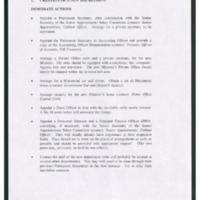
Minute - Creation of a New Government Department [2000-06-16]
Dublin Core
Title
Subject
Description
Creator
Source
Date
Contributor
Minute Item Type Metadata
Transcript
Page 1
CONFIDENTIAL: POLICY
1. CREATION OF A NEW DEPARTMENT
IMMEDIATE ACTIONS
- Appoint a Permanent Secretary, after consultation with the Senior Secretary of the Senior Appointments Select Committee (contact: Senior Appointments, Cabinet Office). Arrange for a private secretary to be appointed.
- Appoint the Permanent Secretary as Accounting Officer and provide a copy of the Accounting Officer Memorandum (contact: Treasury Officer of Accounts, HM Treasury).
- Arrange a Private Office suite and a private secretary for the new Minister. The suite should be equipped with a telephone, fax, computer, Agenda link and television. The new Minister’s Private Office should ideally be situated within the division bell area.
- Arrange for a Ministerial car and driver. Obtain a set of Ministerial boxes (contact: Government Car and Dispatch Agency).
- Arrange security for the new Minister’s home (contact: Home Office Protective Security Unit).
- Appoint a Press Officer to deal with the inevitable early media interest. A No.10 press notice will announce the change.
- Appoint a Personnel Director and a Principal Finance Officer (PFO), consulting, if necessary, with the Senior Secretary of the Senior Appointments Select Committee (contact: Senior Appointments, Cabinet Office). They will ideally already have experience in their respective fields. They should set to work on the practical arrangements as early as possible and should be provided with appropriate support1. (The two posts may, of course, be held by one officer).
- Contact the staff of the new department (who will probably be located in several other departments). This may well need to be done through their previous Permanent Secretaries in the first instance. Try to allay their inevitable concerns.
1 Also see early requirements list.
CONFIDENTIAL: POLICY
Page 2
CONFIDENTIAL: POLICY
- Commission briefing on all areas of activity (from staff in post at the time of the announcement) to brief Ministers. The briefing should flag up any current ‘hot topics’ or areas which require early decisions.
- Speak to someone who has recently been in this situation, who will provide advice on problems and solutions they found (contact: Central Secretariat, Cabinet Office).
EARLY REQUIREMENTS
- Consider the general “esprit de corps” of the new staff at a time of change, and place it high on the management agenda. Appoint someone to be in charge of the human element of the process;
Appoint an interim management board, and convene an immediate meeting. At (or before) the meeting the following tasks should be assigned:
- An in-house legal advisor should be appointed, or else arrangements should be put in hand to ensure that legal advice will be available from the Treasury Solicitor. The Department’s Legal Advisor should then consider:
- ‘Seals of State’ – locate existing ones, or have new ones created (contact: Privy Council Office);
- Transfer of Functions Orders;
- Corporation sole; and
- any other legal and constitutional matters which can be identified.
- The Personnel Director should:
Infrastructure
- appoint a team to manage the “infrastructure” changes – to manage the project of bringing all the practical aspects of the new department on stream, on schedule, and develop a priorities list (personnel information systems, accommodation, IT, facilities management, central services, furnishings etc.);
CONFIDENTIAL: POLICY
Page 3
CONFIDENTIAL: POLICY
- appoint a professionally qualified Head of Procurement with a remit to consider which IT and non-IT support services should be provided in-house and which should be bought in. They should establish close links with the Office of Government Commerce;
- define the departmental remit/structure (possibly with a consultant);
- find a building for the department, if a new one is needed (contact: Property Advisors on the Civil Estate (PACE));
- find suitable accommodation and appoint staff for any junior Ministers as they are appointed;
- change building signage, local road signs, etc. to identify the new department;
- instruct security personnel to accept passes from any former department or else issue replacement passes for the new department;
- provide switchboard staff with staff lists and a list of the duties of all parts of the new department and ensure switchboard operators respond with the correct title of the new department;
- produce an accurate staff directory and telephone directory as soon as possible;
- identify and publish information on a common public enquiry point;
Staff Issues
- undertake a ‘fact-finding’ exercise to locate all the staff who will form the new department. Put in place personnel management systems as quickly as possible and establish clear and effective lines of communications with exporting departments’ personnel divisions;
CONFIDENTIAL: POLICY
Page 4
CONFIDENTIAL: POLICY
- write to all staff as soon as possible with full details of the formal arrangements and conditions of their transfer;
- consider the size and organisation of the senior structure within the new department. Consult with the Senior Civil Service Group about the senior structure, numbers and JESP ratings (contact: Senior Appointments, Cabinet Office (OPS));
- consider the pay and grading systems for the new department. If at all possible, consult widely on the structure of the new system, involving staff at all levels as much as possible. Reassure transferring staff that they will not “lose out” under any new pay and grading arrangements; issue guidance to staff transferring to the new department. Ensure that, as far as possible, the advice given to staff by exporting departments is consistent, particularly as regards any rights to return to former departments; and
- maintain regular communications with staff, by whatever means. The more that can be done to involve new staff in decisions about the future of the new department, the better.
The Principal Finance Officer (PFO) should:
- speak to the Treasury Officer of Accounts about PES transfers;
- arrange Votes (detailed advice should be sought from the Treasury Officer of Accounts);
- establish a contact point or identify an expenditure team in the Treasury;
- organise banking arrangements for the new department, so that payments can be made and receipts banked;
- agree transition arrangements with departments relinquishing responsibility to enable a smooth transfer of functions and a clear understanding of relative responsibilities;
CONFIDENTIAL: POLICY
Page 5
CONFIDENTIAL: POLICY
- initiate a project to implement financial management and control arrangements and accounting systems (all of which might be managed internally, delivered by a contractor or left, for the time being, with another department); and
- make arrangements for a payroll service for paying staff and Ministers.
GENERAL
The new Department should also:
- set up a Parliamentary Branch, and arrange the mechanics for the handling of Parliamentary business;
- set up a correspondence branch (contact Service First Team in Cabinet Office for advice on best practice in handling correspondence);
- seek the Minister’s views on the Departmental objectives and remit, against the background of the No.10 press notice announcing the machinery of government change. In addition, new Ministers may want a list of relevant visits to make and people to meet;
- develop a interim corporate identity (letterhead etc.), and set to work creating a permanent one. Arrange for an initial Internet home page on the CCTA Open Government Internet site; and
- identify any non-departmental public bodies (NDPBs) or other bodies which need to transfer to the new department. Consider any outstanding appointments to these bodies. The Chairmen of any NDPBs or other bodies transferring should be informed of the change in sponsoring department as soon as possible (contact Central Secretariat, Cabinet Office).
CONFIDENTIAL: POLICY
Page 6
CONFIDENTIAL: POLICY
2. MERGER OF EXISTING DEPARTMENTS
The following action needs to be taken as quickly as possible to remove uncertainty and reassure staff that there is a management plan and that it is being implemented effectively.
IMMEDIATE ACTIONS
- Communicate as soon as possible and as much as possible to the staff of both former departments. Try to have site meetings addressed by top managers on the day of an announcement. Also, pay special attention to those areas where functions are most affected by rationalisation, such as Private Offices, key finance posts and the Library.
- Establish a Transitional Management Board from top managers of both departments as soon as possible. The Board should meet within the first week.
- Draw up a draft aims and objectives for the new department. If at all possible, consult widely but swiftly, both internally and externally on these. This will help create a sense of ownership and involvement in an important new venture.
- Decide how posts will be filled. In a merger there are likely to be some staff without posts at the end of the merger. Decide the principles that will be used and say to all staff what these will be. Be clear and honest about what their options will be. If there is competition for posts that should be seen to take place for top posts as well as for others.
- Make a statement, early on, about the way the department will work – whether this is in the form of a values statement or a broader statement about what the department will stand for. This must then form the framework for all management initiatives and system reviews.
- Ensure that, once appointed, the new Board is visible on all sites and prepared to share problems as well as aspirations.
- Explain the policy reasons for the merger – no doubt captured in the new department’s Aims and Objectives. Establish a specific area or areas where some early practical fruits of the merger will be seen and make this part of the whole department’s understanding.
CONFIDENTIAL: POLICY
Page 7
CONFIDENTIAL: POLICY
- Involve staff at all levels in drawing up systems and processes which will underpin the new department – aim for an approach which builds on good practice in the previous departments. Identify the areas where compatibility is likely to be a problem (e.g. pay and grading systems and information technology systems) and focus on these. Be clear about why particular systems are used. Consider new systems where neither of the two departments’ systems merit general application. Avoid a take-over feeling if one department’s systems are used en bloc.
- Aim for significant cross-posting between old parts of the new department. Avoid enclaves which are untouched by the new department and which preserve their own culture.
- Draw up a training and development strategy which supports the new department’s objectives and preferred ways of working.
CONFIDENTIAL: POLICY
Files