Miscellaneous - Memorandum on the Making of Bishops [1908-01-22]
Dublin Core
Title
Subject
Description
Creator
Source
Date
Contributor
Miscellaneous Item Type Metadata
Transcript
Page 1
[This Document is the Property of His Britannic Majesty's Government.]
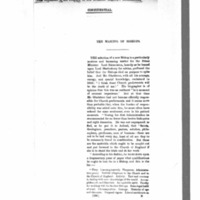
THE MAKING OF BISHOPS.
THE selection of a new Bishop is a particularly anxious and harassing matter for the Prime Minister. Lord Palmerston, heavily as he leaned upon Lord Shaftesbury for advice, professed the belief that the Bishops died on purpose to spite him. And Mr. Gladstone, with all his courage, energy, and special knowledge, exclaimed in 1868: "I think these Church preferments will be the death of me!" His biographer is of opinion that this was an outburst "in a moment of unusual impatience." But at that time Mr. Gladstone had not become officially responsible for Church preferments, and it seems more than probable that, when the burden of responsibility was added unto him, he must often have echoed the same sentiment, even in his patient moments. "During his first Administration he recommended for no fewer than twelve bishoprics and eight deaneries. He was not unprepared to find, as he put it to Acland, that 'Saints, theologians, preachers, pastors, scholars, philosophers, gentlemen, men of business—these are not to be had every day, least of all are they to be commonly found in combination. But these are the materials which ought to be sought out and put forward in the Church of England if she is to stand the trials and do her work.'
"According to his fashion, he wrote down upon a fragmentary piece of paper what qualifications he ought to look for in a Bishop, and this is the list:—
"Piety. Learning (sacred). Eloquence. Administrative power. Faithful allegiance to the Church and to the Church of England. Activity. Tact and courtesy in dealing with men; knowledge of the world. Accomplishment and literature. An equitable spirit. Faculty for working with his brother Bishops. Some degree of mind. Circumspection. Courage. Maturity of age and character. Correct views. Liberal-mindedness on
Page 2
public affairs. A representative character with reference to shades of opinion fairly allowable in the Church."*
Mr. Disraeli appears to have taken this part of his duties very seriously. Witness the letter in which he offered the Archbishopric of Canterbury to Dr. Tait, then Bishop of London: "It is my desire, if it meet your own wishes, to recommend Her Majesty to elevate you to the Primacy. I can assure you, in so doing, I feel a responsibility as grave as any your Lordship can experience if you accept this paramount trust, but I believe that I am taking a course which will be the most serviceable to the Church, especially at this critical moment in its history."†
Tait gave the following amusing account of his interview with Disraeli before the appointment was carried out: "The servant announced me as Archbishop of Canterbury, on which I said that was not my mode of announcing myself. This led him to say that he had hoped to keep the matter secret till all his appointments were ready. Then he harangued me on the state of the Church; spoke of nationalists; explained that those now so called did not follow Paulus. He spoke at large of his desire to rally a Church party, which, omitting the extremes of rationalism and ritualism, should unite all other sections of the Church; alluded to the Church appointments as aiming at this—Champneys, Merivale, Wordsworth, Gregory, Leighton, myself, Jackson. He promised to support a Church Discipline Bill, but deprecated its being brought in by Lord Shaftesbury. Remarked that, whether in office or out, he had a large Church party. . . . . I stated my views shortly, and we separated."‡
It is said§ that Lord Salisbury laid predominant emphasis upon the quality of strength. Bishops, in his view, should lead the Church; and leaders
† Compare and contrast Mr. Gladstone's offer to Dr. Benson: "This proposal is a grave one, but it is, I can assure you, made with a sense of its gravity, and in some degree proportioned to it; and it comes to you, not as an offer of personal advancement, but as a request that, whereas you have heretofore been employing five talents in the service of the Church and Realm, you will hereafter employ ten with the same devotion in the same great and good cause."—"Life of Benson," by his son, p. 217.
‡ "Life," by present Archbishop of Canterbury, i. 286.
§ I have this from the Bishop of Southwark, who heard it from Lady Gwendolen Cecil.—H. H.
Page 3
should know their own minds. If they led in the wrong direction the responsibility was theirs, and the mischief would probably be less than if they were weak, wobbling, undecided, inconsistent, without clear principles or power of will. He was therefore accustomed to ask according to circumstances for the name of "a strong High Churchman" or "a strong Evangelical" or "the strongest man to be found," and he appears to have been very little troubled by the reflection that the responsibility for the direction in which the Bishop pressed against the collar was shared in a great measure by the Minister who selected him, or by the danger of finding strength and narrowness combined, or the second mistaken for the first.* But, in truth, general principles—how simple or how complex soever—must be applied with discrimination according to the circumstances of the time in the affairs of the Church and in the particular diocese. The best of Bishops in one diocese may be a comparative failure in another, while the composition of the Bench of Bishops, considered in relation to the general feeling of the laity, may well require some counterpose by a departure from a long and consistent line of selection.
The first difficulty with which the Prime Minister is confronted is the absence of such hierarchical gradation as is to be found in the organized services of the State, where a vacancy in one rank is naturally filled from the ranks below, where training and experience give some guarantee of fitness for higher duties.
Suffragan Bishops do not, as such, receive any emoluments, and are usually chosen by the Bishops from the very restricted field of those clergy in their own diocese who are possessed of ample private means.
Colonial Bishops are appointed without the intervention of the Prime Minister; and the experiment of bringing them home to an English diocese has been made only four times in the last
Page 4
forty years, and only once with conspicuous success, when Dr. Moorhouse (who had been a considerable figure in this country before he went to Melbourne) was appointed to Manchester.
Deans are usually past very active work outside their study. To preach a few sermons a year, and preside occasionally over a Chapter, is a pleasing prospect for a clergyman who feels no longer equal to the stress of parish life, and desires the leisure of a cloister in order to serve the Church with his pen. But it is less alluring to the young and energetic men who have in them the stuff from which Bishops can be made.*
Perhaps the primary requisite in a Canon is preaching power, but his fitness for a Bishopric is no more attested by experience than that of a simple incumbent. And, indeed, previous experience itself has been considered to be of little value as a guide to the subsequent bearing of a Bishop. Dean Swift asserted that the King always makes good Bishops, but that on their way across Hounslow Heath their carriages are stopped by highwaymen, who steal their clothes and take their places!
As there is no limit of age for the retirement of a Bishop, no Government control over him when he is appointed, and no certainty how he will develop, the Prime Minister must naturally feel the heavy responsibility of a layman who is about to take a step of grave consequence to the life of the National Church. He may, indeed, fortify himself with the opinions of high ecclesiastics, which are of the greatest value as warnings against unassailable men, but there is a wide-spread conviction, even within the Church, that it would be disastrous to allow the Bishops to co-opt their brethren. An irresistible tendency to "vote in" men of their own colour would militate against comprehensive representation of the various schools of Anglican thought, and would tend to stereotype the ecclesiastically-minded clergyman, who is sometimes referred to as "by no means a layman's Bishop."
Seeing that Bishoprics vary considerably in value and importance, it might be thought natural to translate a Bishop of approved merit
Page 5
to a more important diocese when a vacancy occurs. But it is alleged that such a practice is "contrary to Catholic order, . . . Apart altogether from the view which finds an analogy between the relation of a Bishop to his See and that of a husband to his wife, it seems wrong to take a prelate from his work just as he has got in touch with his clergy and people, and it is even worse when the people of one diocese covet the Bishop of another."* Even those who hold this view, however, illogically allow exceptions in the cases of Canterbury, York, London, Durham, and Winchester.
The principal prevalent opinions, sometimes confused, sometimes conflicting, and presented in numberless combinations, may be set out in the form of an imaginary conversation:—
A. A Bishop ought first of all, and above all, to be a saint. A man in whom the spirit of holiness burns like a flame, whose life and character compel reverence both for himself and for his religion, cannot fail to gain the love and respect alike of the clergy and the laity in such a degree as to make his path smooth. If we are to judge a range of mountains by its highest peak, we must judge the Church by its highest dignitaries. A saintly Bishop adds lustre to the Church for all time, raises its spiritual tone, and strengthens its hold upon the affection of the people.
B. These are probably the views which commended themselves to the Conclave at the election of the last Pope. Does the result satisfy you? Does it satisfy the best men in the Roman Catholic Church?* Can anything be more disastrous to the growth of the Church than the uncompromising attack upon Modernism? If you want to attract or retain thinking men you must recognize the fact that they read and reflect for themselves,† that their
† "In the twentieth century many of the laity are as intelligent, as well educated in religious matters, and possess as much power of independent judgment as the clergy; but it means of acquiring it to those of the bulk of the clergy."—Bishop of Carlisle in the "National Review," January 1908, p. 742.
Page 6
intellects rebel against the strict, literal, narrow acceptance of every word of our present version of Scripture, and if this is forced upon them they will leave the Church to women and children.
A. French prelate, who was recently on a visit to this country, was asked whether the policy of Pius X would lead to a split in his Church. His answer was, "Il n'y a pas assez de religion en France pour faire du schisme!" What is wanted is a man who will interpret the essentials of Christianity in the light of textual and historical criticism and modern ideas, and will not persist in divorcing religious teaching from common-sense. Give me a liberal theologian of germinal ideas, one will bring new thought and new life into the Church, a man abreast of actuality, who recognizes with Bishop Butler that "things are what they are," and whose attitude to his flock is, "Come, let us reason together." For such a man I look to the Broad Church party.
C. To some extent I agree with you, but where is your "germinal man"? If you can find him he is more than likely to wound the most cherished convictions of the vast majority of Churchmen. According to Adam Smith if we said of the laws of Solon, that, though not the best in themselves, they were the best which the interests, prejudices, and temper of the times would admit of.* Opinion is not ripe for the general acceptance of such new theologies as are brandished about. By all means appeal to the intellect rather than the emotions. Emotional influence produces but a transitory effect. Even when fruits are visible they are prone, like Jonah's gourd, to wither in the morning. And this is one of many objections to the ornate services of extreme ritual. The man we want is a sane and sober theologian, whose teaching anchors itself in the mind by conviction, and who recognizes that spectacular services are suspicious as an end, distracting, if not futile, as a means of carrying out the mission of the Church. I therefore desire a good Evangelical, content with the Prayer Book as it is, and duly impressed with the duty of observing the law as it stands, and of repressing within his diocese the irregularities which stir up so much strife and dissipate our energy into heat.
Page 7
D. You talk of observing the law, but what is the law? And even if we were agreed upon what it is, why is the law of the Church to be the only rigid thing in the law of the State of which it forms a part? You remember Matthew Arnold's definition of religion as "morality touched by emotion." Emotion there must be. The little more or the little less can hardly be ruled out of so comprehensive a body as the Church of England. We High Churchmen claim to be loyal members of the Anglican Church, and we believe that our services are historically and canonically justified. If they were not they ought to be, for a strong argument is our success. The crowded poor, who pass their dreary lives throughout the week unrelieved by a touch of colour, enjoy their Sunday services with lights and incense and vestments and choral celebrations. And if their emotions take them for a time out of themselves, the change is to them a rest and refreshment, and so they grow attached to the Church services. Be more what you regard as the adventitious features of the services and you empty your Church and lose your hold upon the people. Even the allimportant duty of visiting the parishioners is immensely facilitated when they are Churchgoers, when they are familiar with the face of their parish priest, and associate him with some of their happiest moments. Surely much of the best work among the poor is to be set to the credit of the High Church party. Among them are to be found a large proportion of the keenest workers, the most fervent and devoted Churchmen, the men of tenderest social sympathies, and in every sense of the word the most "popular" of the clergy. And it is among them I would look for a Bishop.
E. You fail to mention their essential quality—the possession of the sacerdotal spirit. To my mind, the great distinction between the Church of Rome and the Church of England lies in this, that the Roman priest belongs to a special caste. He is distinguished from the laity by vestments, by incense, by a different form of Communion at Mass, by compulsory celibacy, and by the general powers of a director of conscience, and a sanctifying priest—a necessary intermediary between his people and the Deity.
This arrogance of a superior class is in itself an anti-social survival. The gravest danger of
Page 8
the Church of England is coming from the extreme High Church party, who by striving to bring us back to sacerdotalism are digging wider the breach between clergy and laity, Churchmen and Nonconformists. Let the priest be our friend and Minister, not our master, and I mind very little your quarrels about theological or liturgical differences. I sweep all this aside and say, "Let me have a man of liberal and progressive views in social matters. Preach to the poor by all means, but range yourself on the side of those who are fighting to raise him out of poverty." I care less about Foreign Missions or the Propagation of the Gospel among the Jews than for reform of the conditions which make it difficult, almost impossible, for many of our own countrymen to lead decent and self-respecting lives in their present surroundings. I attach less importance to a knowledge of patristic literature than to an acquaintance with such matters as overcrowding, charity organization, poor-law administration, and the like. A Bishop becomes in course of time a Peer of Parliament; but before that, and apart from that, he has an enormous influence in his diocese, in directing the thoughts of his people in the direction of material as well as moral reforms. In other words, I want a Bishop to be something of an economist, something perhaps of a socialist in the best sense—a "citizens' Bishop."
F. Have you noticed how early in his list Mr. Gladstone mentions administrative power? A Bishop is a great permanent official of the Church, and ought to have many of the qualities of a great permanent official of the State—organizing ability, business method and capacity, discipline, decision, a head for finance, a well-balanced judgment in comparing the advantages and disadvantages of different proposals, and especially the imagination which is needed for striking out a newer and better plan than any of those proposed. Is a man a scholar and a student, still engaged in research and extending the bounds of knowledge—let him be made a Dean. Is he an orator—let him be made a Canon. Is he a hard-working incumbent, holy in life and an active visitor and pastor—I hope that he differs very little from thousands of his brethren in these respects. But the multifarious duties of a Bishop, the number and
Page 9
variety of business matters which require his attention every day, demand special and different qualities from these. I am not at all sure that it would be a bad thing for the Church to send a few selected representatives, as the army sends a few officers every year, to go through a course of training in finance, public administration, economics, statistics, and social problems in the Economic Faculty of the University of London. At present I should look for the most promising material to the head-masters of our great public schools. There you have men of distinction, of learning, skilled in the art of management and of obtaining obedience, men of business and men of character, possessed of the private means which are, unfortunately, so often indispensable. They have given us a Tait, a Benson, and a Temple, to say nothing of others. They are the very flower of a large section of the clergy; and a public school is, perhaps, the best training ground for the work of a Bishop which at present exists.
G. How you can think so passes my comprehension! What experience of parish life has a schoolmaster got? Sometimes his hold on a curacy for a year or two. In many cases he has never been even a curate. To govern a battalion of boys is a very different matter from dealing with men and women and the general relations of society. If a diocese is a parish writ large, an ignorance of parish problems should be almost a bar to appointment as a Bishop. I hope that we are far distant from the day when Bishops are to be selected, as by a Chinese principle of examination, from those who are learned in books without guarantee against their ignorance of life. A Prime Minister once inquired about a clergyman who was doing an admirable work, and was informed that he possessed an almost miraculous influence, especially over men, and that he had done perhaps a greater amount of successful parish work among the poor than any one else who could be named, but that he lacked a University education, was suspected of neglecting his aspirates, and spoke with a slight provincial burr. To which the Prime Minister replied, "The first Apostles were fishermen. It would not be surprising to learn that St. Peter dropped his h's, or that Our Lord addressed His followers in the broadest Galilean."
Page 10
"After all, is it fair to the working clergy, who have borne the burden and heat of the day, have visited the sick and poor, have attended the dying at all hours of the day and night, have preached, have fostered guilds and societies, have spent their means as well as their lives in the daily service of the Church, that you should take men who have earned incomes of thousands a year, without doing more Church work than preaching an occasional sermon, and then should put them over the heads of the working clergy into the highest places of the Church? Surely it is enough to take the heart out of them if ever they think of preferment. No! Give me an active working clergyman, vigorous in mind and body, and above all things young. Of course he must have attained an age when his character and his judgment are formed, but nothing can be worse than appointing a Bishop at so advanced an age that he has lost much of his physical power and something of his flexibility of mind. To take a man who is nearly 70, to set him among strange faces, to learn new duties, to be constantly travelling about, grappling with new perplexities, is a dangerous experiment. Even if it succeeds, the time must soon come when, having just become acquainted with his people and his duties, his experience is lost by death, or he suffers the disabilities of old age and lags upon the stage while Suffragans and Assistants imperfectly take his place. The proper training ground for a Bishop is the Bishop's Palace, and not a University class-room. Pick them out young, and there is a probability of your having for many years the benefit of vigour, of training and experience.
H. I shall shock you all when I say that if I were Prime Minister at present I would look in the first instance to those clergy who are Liberal in politics. It is all very well to talk about keeping politics out of religion, but how are you to keep religion out of politics? In the Education question, the Deceased Wife's Sister question, the question of Disestablishment, you have a distinct Church party fighting in the field of politics with political weapons. I say nothing about my preference for a man in sympathy with progressive political ideas and with "liberal sentiments on public affairs." I take my stand upon the fact that the Bishops are too much identified with one political party. Things are not so bad, in this respect, as they
Page 11
were in the time of William IV,* but there is still a feeling that a Bishop ought to "drive away all strange doctrine," political as well as theological. The great majority of the people have recently declared themselves on the side of the Liberal party. Of the twenty-seven Prelates who sit in the House of Lords, is there more than one who can be regarded as an undoubted supporter of the Government? You may tell me that the clergy are generally Conservative in politics, but can any one suppose that the disparity is so great as this, or that it is desirable that the Bench of Bishops should be practically solid on the other side of politics from the mass of the electorate? Many years of Conservative patronage have brought about a state of affairs which makes it possible for the majority of people to look upon the Bishops, rightly or wrongly, as a body of political opponents. We are familiar with the complaints which have been made about the one-sided appointments of Magistrates, and I think it is as desirable in the case of the Episcopal Bench that the balance should be corrected, that the Liberals should have their turn, and that the Crown should for a time look first among the Liberals, if only to remove its grace when no suitable man can be found. For the same reasons I would at present give a preference to the Broad Churchman and the Low Churchman, who are under-represented among the higher dignitaries of the Church, and would try to make the Bishops more representative of the Church, and especially the laity, in theology as well as in politics.
J. Perhaps my suggestion will seem to you a little fantastical; but I think it would be a good thing to fight against the tendency to regard a diocese as if it were ear-marked to a particular party in the Church. Assume that the parties are fairly represented upon the Bench,
In 1829 the Bishop of London (Blomfield) thought it necessary in the House of Lords to apologise for adopting a more extreme party to that to which the Minister (Wellington) who had nominated him to his Bishopric.—Hansard, lxii, 122.
Page 12
and that a High Church Bishop dies after ruling his diocese for, say, fifteen years, would it not be desirable, in the interests of fairness, to translate a Low Church Bishop who has been some time in office, and replace him by a High Churchman? Those who have hitherto basked in the sunshine of approval will be all the better for a little criticism, and those who have been looked at askance will be much the better for a little sympathy. The life tenure of a benefice is one of the weaknesses of the Church of England. Nonconformists, when in their generation, move their men every few years, and similar arrangements might be good for our men and good for our parishes. I see no reason why what is good in this respect for a parish should be bad for a diocese. A change would be like a breath of fresh air when "one good custom" threatens corruption.
This babel of voices by no means exhausts the representations which are made. A Diocesan Bishop recently mentioned to me that in his opinion a Colonial Bishop was not suited to high preferment at home, because "his grandfather held a not very high social position.
Even when the Prime Minister has made up his mind on the general principles involved, the search for the man he desires is exceedingly difficult. The Chancellerie here is swept clear at the advent of a new Administration. The published biographies of Prime Ministers, Archbishops, and Bishops are almost the only sources of information we possess as to what has happened in times past. Information confidentially supplied about the qualities and defects of eminent Churchmen disagreeing with the Minister for whom it is obtained. In process of time a Prime Minister learns with difficulty of the personal failings of this man or that, and is warned of objections to many of those to whom his thoughts might naturally have turned. One man is considered flippant in his treatment of sacred subjects; another is flat in the pulpit and lacks spiritual power; another is stinging to his superiors, arrogant to his inferiors; another is tactless and violent in temper; another is too poor to support the burden of an Episcopal Palace; another has an unsuitable wife, &c. The positive legal requirements are very few. A Bishop of the Church of England must be a
Here is the transcription of the text:
learned presbyter of at least 30 years of age,* born in lawful matrimony,† and of good life and behaviour. There is no positive stipulation, as there is in the case of most Deans and Canons, that he should be possessed of a University degree.
As to an upper limit of age, compare the following letter from Bishop Harold Browne, of Winchester, 21st December, 1882: "On Wednesday night I received a long and kind letter from Mr. Gladstone, from which it appears that both he and the Queen had been very desirous of offering me the Primacy, but that they came to the conclusion that the duties were too new and onerous to be undertaken by a man of over 70, no one of that age having been elevated to the Primacy of the English (now the 'Anglican' or 'British' Church) since Juxon, whose case was very exceptional."
Notwithstanding this, Dr. Temple was within a month of his 75th birthday when he accepted the Archbishopric of Canterbury. Lord Salisbury appears to have thought that the duties of the Archbishop were no heavier than those of the Bishop of London.‡ Archbishop Tillotson is the last Primate who was appointed (1691) without being already a Bishop.
Before deciding upon the name of a new Bishop, the Prime Minister usually has recourse to the Archbishop of Canterbury—in the words of Mr. Gladstone, "for information and advice." But on one occasion, at least, Mr. Gladstone went much further and postulated agreement. In the diary of Archbishop Benson, i. e. the following entry under the date 22nd January, 1885: "A long talk with Mr. Gladstone to wind up our
* The Canon Law gives as a reason that our Saviour was baptized and began to preach at this age.
† This is a bar to the further preferment of at least one of the higher clergy.
‡ Lord Salisbury's letter ran as follows: "I am authorized by Her Majesty to propose to you that you should be nominated to the Archbishopric of Canterbury, vacant by the lamented death of Archbishop Benson. I need hardly enlarge on the great office which is vacant, nor on your own preeminence position in the Church of England, which designates you as the fittest person to undertake it. I believe it will not involve any labours in excess of those which are now incumbent on you and to which your strength is fully equal. But no doubt any burdens in excess of those which are office, I am convinced all who love the Church of England will regard the great as one of singularly auspicious presage for her welfare."—"Life of Temple," ii 245.
conversation. He refused to appoint the Bishop of London except on my recommendation. We thought, on the whole, though I never in my life had such subtle difficulties and differences to weigh, that it was best that the Bishop of Durham (Lightfoot) should work out further the great things which he had begun in his northern region with such great power—that he had better be reserved for the Archbishopric of York, and that neither his present work nor the Archbishopric would in so grave a way hinder his theological work, 'so essential for the Church,' as London would undoubtedly end it. We therefore determined on the Bishop of Exeter, who (without mentioning my name) is to be recommended at once to the Queen. No other name was even discussed."*
When the Prime Minister has settled his choice he formally consults the Sovereign, and requests authority to make the offer. Queen Victoria was accustomed at this stage to seek the opinion of the Dean of Windsor (Wellesley), and the King is believed to refer to the Archbishop of Canterbury. If difficulties are raised which cannot be surmounted the name is withdrawn and another name is put forward, and the process must, if necessary, be repeated until it is successful. The initiative rests with the Prime Minister, the power of rejection with the Crown. Suggestions have recently appeared in some of the High Church papers that the King should resume the "ancient right of the Crown" to appoint the Bishops of his own motion without the intervention of a Minister. But this proposal rests upon a shallow acquaintance with history, and is opposed to constitutional law and practice.
A list of the Bishops and Archbishops appointed since Mr. Gladstone formed his Second Administration in 1880 is printed as an Appendix, together with a statement as to the formal method of appointment.
HENRY HIGGS.
10, Downing Street,
January 22, 1908.
* "Life of Benson," p. 285
(Appendix I on pp. 15-16 is omitted.)
APPENDIX II.
Mode of Appointment.
WHEN a name is agreed, the Sovereign's pleasure is formally taken by the Prime Minister, and on receipt of His Majesty's approval a letter is written to the Home Office stating the name of the last holder of the See and the cause of the vacancy, and requesting that steps may be taken to issue a congé d'élire with the licence to the Dean and Chapter of the diocese of the Church of England for electing the Home and Crown Offices nominating the person to be elected. The election, which must take place within twelve days of the congé d'élire, is certified to the King under the common seal of the Chapter, and is usually sent to the Prime Minister, who forwards it to the Home Office. The certificate is then submitted to the King for the Home Secretary, when a second patent is issued certifying the Royal assent to the election and directing the election to be confirmed by the Archbishop of the province. After confirmation the new Bishop is consecrated (the consecration must be held on a Sunday or Holy-day within twenty days of the confirmation), takes the oath of allegiance to the King, and does homage to the King. A third patent is also issued restituting the temporalities of the See.
In cases where there is no Dean and Chapter competent to elect, only two patents are necessary, the first nominating the person to be appointed (which takes the place of the two first patents mentioned above) the second restituting temporalities.
It is to be observed in 1897 that a new Bishop is not entitled to patronage till he has done homage. Patronage of benefices in some sees which fell vacant after appointment ceased at a later date.
Page 17
APPENDIX III.
The First Epistle in the Consecration Service.
"THIS is a true saying, if a man desire the office of a Bishop, he desireth a good work. A Bishop, then, must be blameless, the husband of one wife, vigilant, sober, of good behaviour, given to hospitality, apt to teach; not given to wine, no striker, not greedy of filthy lucre, but patient, not a brawler, not covetous: one that ruleth well his own house, having his children in subjection with all gravity (for if a man know not how to rule his own house, how shall he take care of the Church of God?); not a novice, lest being lifted up with pride he fall into the condemnation of the devil. Moreover, he must have a good report of them which are without; lest he fall into reproach and the snare of the devil."—St. Paul, i Timothy. iii. 1–7.
For an interesting discussion upon the qualities of a Bishop, see the sermon preached by Canon Beeching at the Consecration of the Bishop of Winchester, the 25th January, 1905, printed in extenso in the "Guardian" of the 29th idem. It begins with the words: "Neither of the alternative Epistles appointed for the service of Consecration makes a Bishop has a direct reference to that office, for the reason that the office of Bishop, as we know it, is later than the conclusion of the Canon of Scripture."
Special Features
This illustrates one of the subtler truths of the British constitution: Ministers have no formal mechanism for bypassing a recalcitrant monarch. They can resign in protest, but they're unlikely to take such a drastic step except in the most dire of circumstances. In practice, they will be strongly incentivized to seek a modus vivendi with the Palace.
Files