Minute - Documents Which Receive the Great Seal [1980-08-29]
Dublin Core
Title
Subject
Description
Creator
Source
Date
Contributor
Minute Item Type Metadata
Transcript
Page 1
Miss Malley.
Please let me see
a sample of X. Should we
have to consult the Palace
before initiating a change of practice?
JWB 1/9
Sir Wilfrid Bourne
(not urgent)
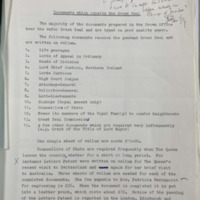
Documents which receive the Great Seal
The majority of the documents prepared in the Crown Office bear the wafer Great Seal and are typed on good quality paper.
The following documents receive the pendant Great Seal and are written on vellum.
1. Life peerages
2. Lords of Appeal in Ordinary
3. Heads of Division
4. Lord Chief Justice, Northern Ireland
5. Lords Justices
6. High Court Judges
7. Attorney-General
8. Solicitor-General
9. Lord-Lieutenants
10. Bishops (Royal Assent only)
11. Counsellors of State
12. Power (to members of the Royal Family) to confer Knighthoods
13. Great Seal Commissions
15. [sic] A few other documents which are required very infrequently (e.g. Grant of the Title of Lord Mayor)
One single sheet of vellum now costs £15-00.
Counsellors of State are required frequently when The Queen leaves the country, whether for a short or long period. For instance Letters Patent were written on vellum for The Queen's recent visit to Switzerland and were again for her brief visit to Australia. Three sheets of vellum are needed for each of the completed documents. The fee payable to Mrs. Patricia Westmacott for engrossing is £50. When the document is completed it is put into a leather pouch, which costs about £10. Notice of the passing of the Letters Patent is reported in the London, Edinburgh and Belfast Gazettes. The Stationery Office now charge £95 for each
Page 2
insertion. Total costs are approximately £390. The method of preparing Letters Patent for Counsellors of State is not affected by Crown Office rRules.
Could a small saving be made if these documents were typed on best quality paper and wafer sealed? I think it is important that notice of the issue of Letters Patent should be reported in each of the three Gazettes.
The completed documents are delivered to the Privy Council Office for safekeeping: so far as I know they are not referred to again.
You may however consider that these documents are of some constitutional importance and that a small saving in the cost of production would not be justified.
[uncertain initials]
Crown Office,
29th August, 1980.
Signatures
Special Features
Files